




Your foreign investor has signed the term sheet. The money is ready. So why is your bank asking for a valuation report?
Because in India, a cross-border share deal is never just a negotiation between buyer and seller. There is a silent third party at the table: the Foreign Exchange Management Act, 1999 (FEMA). And FEMA has one simple worry: India should never sell its shares too cheaply or buy them back at too high a price.
That single idea is what turns an ordinary share issue or transfer into a regulatory valuation. Here is how it works:
Why does FEMA care about price at all?
Every time shares change hands between a resident and a non-resident, foreign exchange crosses India’s border. If shares are issued to a foreign investor below their worth, India receives less foreign capital than it should. If a resident buys shares back from a foreigner at a premium, more foreign exchange leaves the country.
FEMA’s pricing guidelines close both doors. They don’t fix the price. They fix the boundary within which the parties are free to negotiate, and a valuation report is the document that draws that boundary.
When does FEMA compliance trigger a valuation?
The short answer: whenever an Indian company’s equity instruments move across the resident/non-resident line. The usual triggers are: 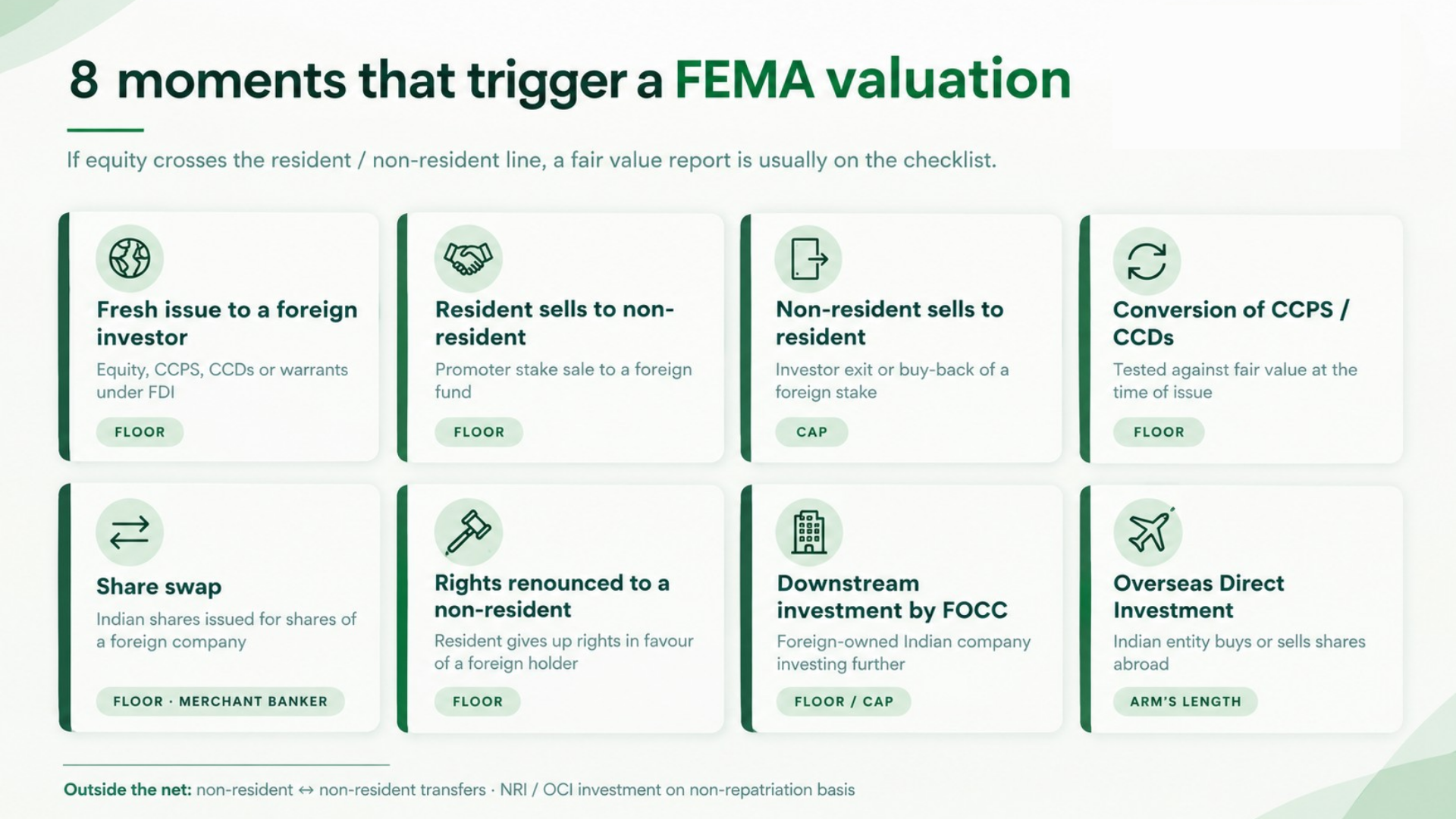
- Fresh issue of shares to a foreign investor (FDI), including equity, CCPS, CCDs and share warrants
- Transfer of shares from a resident to a non-resident, such as a promoter selling a stake to a foreign fund
- Transfer of shares from a non-resident to a resident, such as a buy-back of a foreign investor’s stake or an exit
- Conversion of CCPS or CCDs held by non-residents, where the conversion price is tested against the fair value at the time of issue
- Share swaps, where an Indian company issues its shares to a non-resident in exchange for shares of a foreign company
- Rights shares renounced by a resident in favour of a non-resident
- Downstream investment by a foreign-owned or controlled Indian company (FOCC)
- Overseas Direct Investment (ODI), when an Indian entity buys or sells shares of a foreign entity
A few transactions sit outside the pricing net. Transfers between two non-residents, and investments by NRIs or OCIs on a non-repatriation basis, generally do not need FEMA pricing compliance.
Floor price or cap price? Follow the money
Here is the easiest way to remember it: look at which way the foreign exchange flows.
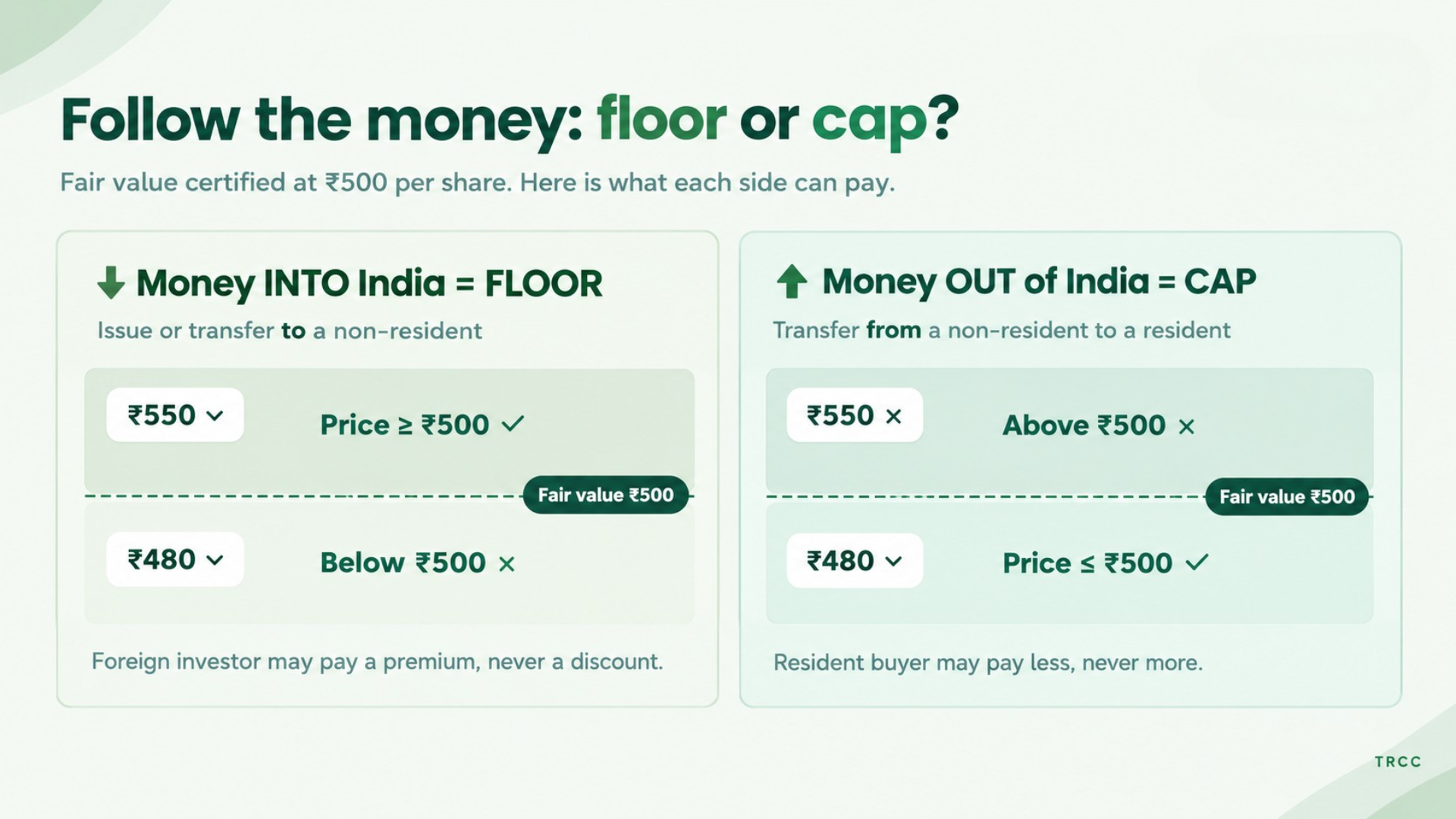
- Money coming into India → Floor price. When shares are issued or transferred to a non-resident, the price cannot be less than fair value. The foreign investor may pay a premium, never a discount.
- Money going out of India → Cap price. When a non-resident transfers shares to a resident, the price cannot be more than fair value. The resident buyer may pay less, never more.
A quick example: a valuer certifies the fair value of an unlisted company at ₹500 per share. A Singapore fund can subscribe at ₹500 or ₹550, but not ₹480. Two years later, if the Indian promoter buys the fund out, the price can be ₹500 or ₹480, but not ₹550 (based on a fresh valuation at that time).
Two twists catch many companies off guard:
- Convertibles lock in early. For CCPS and CCDs, the price or conversion formula must be fixed upfront at issue. At conversion, the price cannot be lower than the fair value worked out at the time of issue.
- Deferred consideration is allowed, within limits. Up to 25% of the price can be paid later, within 18 months, but the total must still respect the floor or cap.
For listed companies, the price follows SEBI’s pricing norms instead of an independent fair value.
Which FEMA rules govern the valuation?
The pricing rulebook is spread across a few key instruments:
Rule / Regulation |
What it governs |
Rule 21, FEMA (Non-Debt Instruments) Rules, 2019 |
The core pricing guidelines: floor and cap for issue and transfer of equity instruments, convertibles, swaps and rights issues |
Rule 23, NDI Rules, 2019 |
Applies the pricing guidelines to downstream investment by FOCCs |
FEMA (Mode of Payment and Reporting of NDI) Regulations, 2019 |
Reporting with the valuation report: FC-GPR within 30 days of allotment, FC-TRS within 60 days |
FEMA (Overseas Investment) Rules, Regulations and Directions, 2022 |
Pricing guidelines for ODI: buying or selling shares of a foreign entity at an arm’s length fair value |
Who can certify the fair value?
That depends on the deal. When an unlisted Indian company issues or transfers shares across the border, the valuation must be certified by a Chartered Accountant, a SEBI-registered Merchant Banker or a practising Cost Accountant (Rule 21, NDI Rules). Share swaps set a higher bar: only a SEBI-registered Merchant Banker, or an investment banker outside India registered with its home-country regulator, can value them. Overseas Direct Investment works differently; it requires an arm’s length price based on an internationally accepted method, and generally leaves it to the Authorised Dealer Bank (‘AD bank’) to decide which valuation it accepts under its board-approved policy.
What methodology does FEMA prescribe?
Here is the surprise: FEMA does not prescribe a single formula. The NDI Rules ask for fair value worked out as per any internationally accepted pricing methodology, on an arm’s length basis.
It wasn’t always this flexible. India moved from the rigid CCI guidelines (before 2010), to a mandatory DCF (2010), to today’s principle-based approach (since July 2014). The freedom is real, but so is the responsibility: the valuer must pick a method that suits the business and defend it.